What Happened to Monohulls in Charter?
There was a time when planning a sailing holiday meant choosing a monohull yacht. Catamarans were something of a novelty, available in relatively small numbers and generally regarded as an alternative to the traditional cruising yacht. How times have changed.
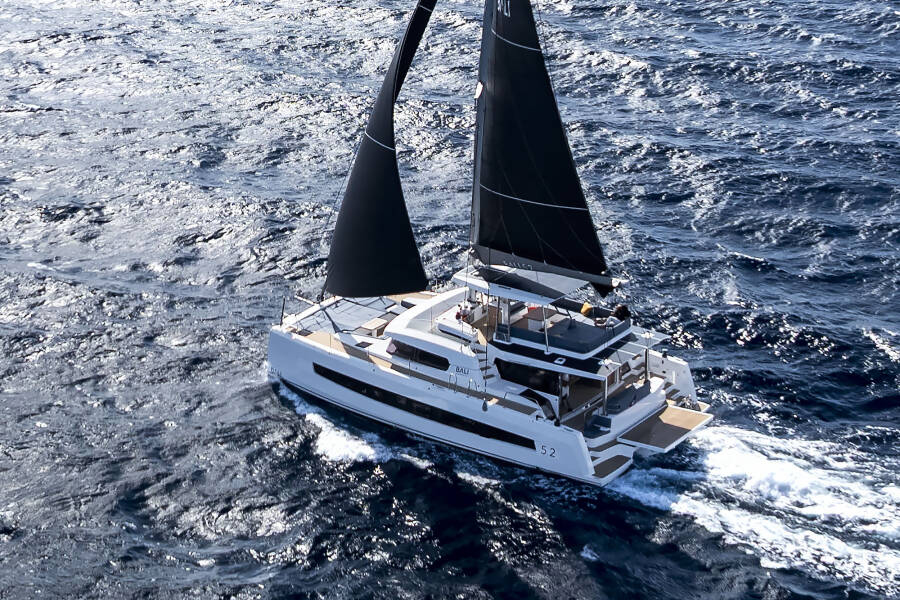
Look through the fleets operating in today's popular charter destinations and you could be forgiven for thinking that catamarans have taken over. They feature prominently in charter promotions, occupy increasing amounts of marina space and are often the first choice for families and groups planning a holiday afloat.
Monohulls have certainly not disappeared, but their once unquestioned position as the standard charter yacht has been supplanted. It is a significant change in an industry that, not so long ago, catered predominantly for people who already knew how to sail.
So what happened? And does the traditional monohull still have a place in the modern charter market?
From Sailing Adventure to Holiday Experience
To understand the change, it helps to consider how the yacht charter industry has evolved.
In its earlier years, bareboat chartering was largely the preserve of experienced sailors. Charterers were generally people who sailed at home and wanted to explore somewhere new. They were comfortable handling a yacht, navigating unfamiliar waters and accepting the occasional inconvenience that comes with life aboard a sailing boat.
The yacht was an essential part of the adventure, not simply a means of getting from one attractive anchorage to another.
Today, yacht chartering appeals to a much wider audience. Many of our clients have little or no sailing experience, while others may have sailed in the past but now prefer to leave the responsibility to a professional skipper.
For these holidaymakers, the attraction is often the freedom to explore beautiful coastlines and islands, swim in secluded bays, visit waterfront villages and enjoy the company of friends and family in a private setting. The sailing is part of the experience, but it is not necessarily the main attraction.
This expansion of the market has been a major factor in the growing popularity of catamarans.
Why Catamarans Have Become So Popular
It is not difficult to understand their appeal.
A cruising catamaran offers generous living space, both inside and out. The wide beam provides a large saloon and cockpit, often on the same level, making it easy for everyone to socialise. Cabins are generally well separated, providing privacy that can be particularly welcome when several couples or a family group are sharing a yacht.
Then there is stability. Catamarans sail relatively upright, which appeals to guests who might be uncomfortable with a monohull heeling under sail. At anchor, the wide platform provides a comfortable environment for swimming, relaxing and enjoying meals outdoors.
Shallow draught can also be an advantage, allowing access to anchorages that may be unsuitable for deeper-keeled yachts.
Modern charter catamarans are increasingly designed around these holiday priorities. Spacious cockpits, forward lounging areas, flybridges on larger models and a growing range of onboard comforts have made them attractive to people who might never previously have considered a sailing holiday.
For a group sharing the charter cost, the additional expense of a catamaran can often be justified by the extra accommodation and living space.
And with the growing popularity of skippered charters, guests do not necessarily need to concern themselves with the differences inherent in handling these boats.
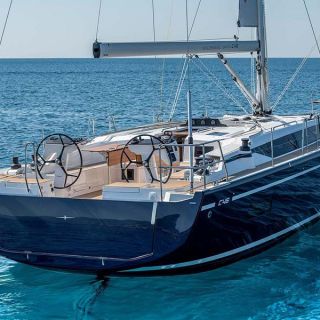
2024-model Bavaria C46
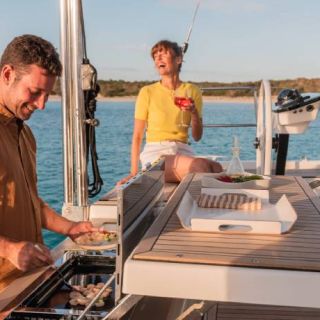
Outdoor living on a Dufour 48
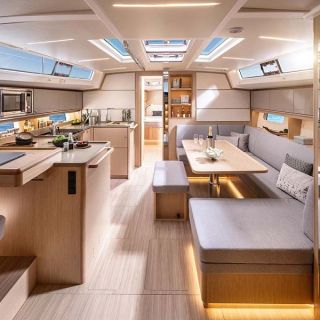
Bavaria C46 monohull saloon
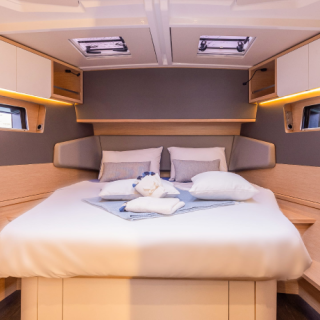
Forward cabin, Dufour 48
But What About the Sailing?
This is where the discussion becomes more interesting.
For many experienced sailors, a monohull offers something that a cruising catamaran cannot replicate.
There is the sensation of the yacht responding to the wind, the heel as the sails fill and the satisfaction of finding the right balance between sail trim, course and conditions. A well-handled monohull can be a delight, particularly on a lively reach or when working to windward.
Of course, catamarans sail too. Some are capable performers with the wind on the beam or following, when in favourable conditions they outpace monohulls. And modern, well-powered cats motor very well to windward.
The typical production catamaran in a charter fleet has, however, been designed with guest comfort and accommodation high on the list of priorities. That’s a different proposition from a performance-oriented multihull.
The modern charter monohull has also evolved, with wider hulls, larger cockpits and improved accommodation. Yet it retains much of the character that attracts people to sailing in the first place.
For those who enjoy being actively involved in the passage, rather than simply arriving at the next destination, that distinction can be important.
It is not necessarily a question of which boat is better. It is a question of what you want from your time afloat.
The Practical Case for Monohulls
There are some sound practical reasons why monohulls remain attractive charter options.
Firstly, they are generally less expensive to charter than catamarans of comparable accommodation capacity. Marina charges can also be lower, particularly where berthing fees reflect the additional space occupied by a multihull.
For couples or smaller groups, a monohull may offer all the accommodation required without paying for space that will not be used.
Monohulls are also generally easier to accommodate in crowded Mediterranean harbours, where berths can be limited during the summer season.
And for those who enjoy longer passages, a suitable monohull can provide a rewarding combination of sailing performance, seaworthiness and comfort underway.
There is still a great deal to be said for a conventional cruising yacht, particularly when the journey itself is as important as the destination.
The Charter Fleets Are Following the Market
Charter operators naturally invest in boats that customers want to hire. As demand for catamarans has grown, so has their representation in fleets around the world.
There is an element of momentum in this. More catamarans become available, more customers discover their advantages, and operators respond by adding more cats.
At the same time, the growing emphasis on skippered and crewed holidays has helped bring sailing destinations within reach of people who would never contemplate taking responsibility for a yacht themselves.
The result is a market increasingly influenced by holiday accommodation expectations rather than traditional sailing preferences.
That does not mean monohulls are becoming obsolete. They remain widely available, particularly in established Mediterranean charter destinations, and continue to attract a loyal following.
Indeed, there is every reason to believe that traditional sailing enthusiasts will continue to seek them out, even if they represent a smaller proportion of the overall holiday market than they once did.
Choosing the Right Yacht for Your Holiday
At Sail Connections, we have seen the industry evolve over many years. Our business has always been about helping people enjoy sailing holidays, whether they are experienced sailors taking charge of their own yacht or holidaymakers who prefer to have a professional skipper aboard. Our role is to offer the boats and arrangements that best suit our clients.
For a family holiday with children, or a group of friends wanting plenty of room to relax, a catamaran may be the obvious choice. For a couple or smaller group who particularly enjoy sailing, a monohull may be more rewarding and more economical.
There are exceptions, of course. Some experienced sailors love catamarans, while newcomers to sailing can discover a real enthusiasm for monohulls. And choosing a skipper does not mean giving up the pleasure of sailing. Guests can still enjoy taking the helm and participating in the passage, while leaving overall responsibility to a professional.
The destination also matters. The ideal yacht for exploring the shallow waters of the Bahamas may be quite different from the one best suited to cruising the Greek islands.
So, Have Monohulls Had Their Day?
Not at all.
What has changed is the nature of the charter market. Sailing holidays are no longer exclusively, or even primarily, about people pursuing their passion for sailing. They are increasingly about enjoying a particular style of holiday, with the yacht providing accommodation, transport and access to places that would otherwise be difficult to reach.
Catamarans have helped make that experience attractive to a much wider audience, and that is surely a positive development for the industry.
But there will always be sailors who appreciate the feel of a monohull under sail, who enjoy trimming the sails while viewing a good passage as one of the highlights of their holiday.
We certainly hope so.
Whether your preference is for a traditional monohull or a spacious cruising catamaran, the important thing is choosing a yacht that suits the people aboard and the experience you want to enjoy. At Sail Connections we will compare suitable yachts and departure bases to help you make the most of your available charter time.