
Not All Charter Catamarans Are Created Equal
Catamarans have become the first choice for many yacht charter holidays, and with good reason. But as the range of boats continues to expand, choosing the right one involves much more than selecting a familiar brand or counting cabins.
There was a time when the choice of a charter catamaran was relatively straightforward. A few established models dominated the fleets, and the main considerations were size, accommodation and price.
Today the market is considerably more interesting. Builders such as Lagoon, Fountaine Pajot, Bali, Leopard and Excess have developed different approaches to designing boats for cruising, each with their own emphasis on sailing performance, accommodation, outdoor living and ease of handling.
For charterers, this variety is welcome. It also means that two boats of similar size, with apparently comparable specifications, can provide quite different holiday experiences.
It's About How You Use the Boat
Most charter holidays involve a combination of sailing, swimming, exploring ashore and relaxing at anchor. Naturally, the balance varies considerably between groups.
Some crews enjoy getting under way early, making longer passages and spending much of the day sailing. Others prefer a leisurely breakfast, a short hop to the next anchorage and an afternoon swimming or exploring ashore.
Then there are the practical considerations. Is the group made up of four couples who would appreciate similar-sized double cabins, each with its own bathroom? Would a smaller group prefer an owner's version with a more spacious master suite? Are there children aboard, or will a professional skipper be joining you? How important is air conditioning, a watermaker or a large entertaining area?
These questions are often more useful than asking which catamaran brand is best.
Lagoon 47: A New Approach to Living Space
The recently introduced Lagoon 47 is a good example of how established builders continue to refine their designs around the needs of cruising crews.
At just under 15 metres overall, it occupies a popular size category for families and groups of friends. Yet its layout introduces some interesting possibilities that would once have been associated with much larger boats.
Perhaps the most striking feature is the substantial forward cockpit connected directly to the saloon by a forward door. This creates another genuine living area rather than simply a place to sit on deck.
Together with the aft cockpit and generous flybridge, the arrangement gives everyone aboard a choice of places to gather or enjoy some privacy. The flybridge combines the helm with comfortable seating, allowing the person steering to remain part of the social activity.
The Lagoon 47 is offered in three and five-cabin configurations, with the latter particularly relevant to charter groups. There is also a flexible space that can serve different purposes depending on the individual boat's layout.
What appeals to us is the attention given to the way people move around and live aboard. It is not simply a matter of making everything bigger. The different spaces are designed to work together. And despite the emphasis on comfort, the Lagoon 47 remains a sailing catamaran, with a modern sail plan intended to provide enjoyable cruising between anchorages.
Fountaine Pajot Aura 51: Space for a Larger Group
Moving up a little in size, the Fountaine Pajot Aura 51 offers another perspective on the modern charter catamaran.
At approximately 15.5 metres, the Aura 51 provides generous accommodation, with layouts ranging from four to six double cabins. For larger groups, particularly those travelling as several couples or families, that flexibility can be especially valuable.
The design makes good use of its substantial beam, with a spacious saloon, open living areas and comfortable outdoor seating. The emphasis is on creating an enjoyable environment for people spending a week or two on board together.
Fountaine Pajot has also invested in improving the energy efficiency of its cruising yachts. The Aura 51 was an important model in the development of the company's Smart Electric technology, incorporating extensive solar generation and alternative propulsion options in selected versions.
These developments are particularly relevant to chartering. Refrigeration, water makers, air conditioning and other domestic equipment place considerable demands on a yacht's electrical systems. Better energy generation and storage can reduce reliance on generators and make life at anchor more pleasant.
Not every Aura 51 in charter will have the same electrical systems or equipment, however. As with all production yachts, the specification of the individual boat is important.
Two Boats, Different Possibilities
The Lagoon 47 and Aura 51 illustrate why we prefer to look beyond the basic specifications.
Both offer the space, comfort and stability that have made catamarans so popular. Both accommodate groups well, and both reflect the progress made in cruising yacht design.
Yet their layouts and available configurations create different possibilities.
The Lagoon 47's connected forward cockpit and multiple social areas may be particularly appealing to a group that enjoys spreading out around the boat. The larger Aura 51 offers generous accommodation options and the additional space that can be valuable when several couples or families are travelling together. Neither is automatically the better choice. Much depends on the actual yacht available, the number of people aboard and the way they intend to spend their holiday.
And there are plenty of other excellent options. We recently looked at the latest developments from Bali in our article Bali Catamarans: Built for the Charter Holiday. Leopard and Excess bring further alternatives to the market, each with distinctive design priorities.
The important thing is to match the yacht to the people, rather than the other way around.
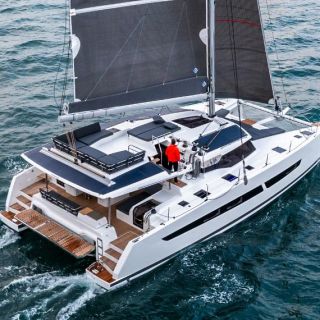
FP Aura 51 under sail
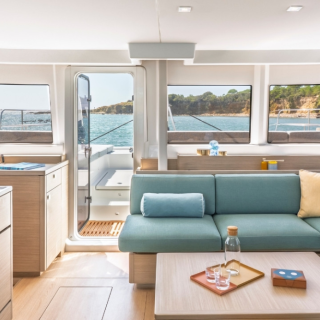
Lagoon 47 indoor outdoor
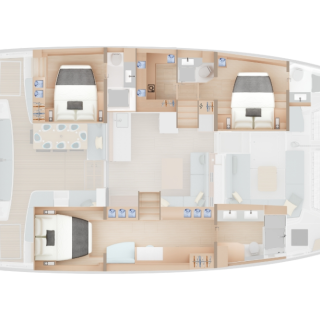
Lagoon 47 owner's cabin layout
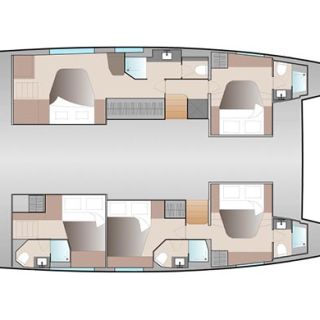
FP Aura 51 5-cabin layout
Understanding Catamaran Cabin Layouts
One of the most useful things to understand when comparing charter catamarans is how their accommodation changes with size. A larger boat does not necessarily mean more cabins. Often it simply means more space and comfort for the same number of people.
The conventional charter layout for catamarans up to around 14 metres/45 feet is four double cabins, two in each hull, usually with their own ensuite bathrooms. This arrangement works particularly well for four couples, giving everyone broadly comparable accommodation and a degree of privacy.
The difference between a 37-foot and a 45-foot catamaran with this layout is largely one of space and budget. The basic cabin arrangements remain similar, but as the boat gets larger, the cabins, bathrooms and shared living areas generally become more generous. For a group of eight, moving up in size can make a considerable difference to comfort without changing the number of people aboard.
Beyond about 45 feet, designers increasingly offer five or six-cabin configurations to accommodate larger groups. These can be particularly attractive for extended families or groups of friends, although adding cabins does not always mean that everyone enjoys the same amount of personal space. The actual layout is worth examining carefully.
There is another option that is sometimes overlooked. Some charter fleets include owner's versions of popular catamarans, often with just three cabins. In these layouts, one entire hull is given over to a spacious master suite, with a large bedroom, generous bathroom and additional storage. The opposite hull typically contains two conventional double cabins.
An owner's version can be an excellent choice for a couple wanting extra comfort while travelling with family or friends. It may also appeal to a smaller group that values space and privacy over maximum sleeping capacity.
Finally, if a professional skipper is joining the charter, their accommodation needs to be considered. Some catamarans have suitable separate crew quarters, while others may require the skipper to occupy one of the main cabins.
The important point is that cabin numbers alone tell only part of the story. We look at the actual configuration of each available yacht to ensure that everyone aboard will be comfortably accommodated.
Why It Pays to Plan Your Charter Early
With so many catamarans now available, it might seem that there is no particular urgency about booking. However, the choice becomes narrower once you specify your preferred destination, dates, budget and accommodation requirements.
A group wanting four similar double cabins, for example, may have several attractive options when planning well ahead. Leave the decision until later and the remaining boats might involve compromises in layout, age, equipment or departure base.
The same applies to popular holiday periods, particularly when several families or couples need to coordinate their travel arrangements.
Early planning does not mean committing to the first yacht offered. Quite the opposite. It gives us more opportunity to compare suitable boats, examine the individual specifications and consider different operators before making a recommendation.
The newest yacht is not necessarily the best choice, either. A well-maintained catamaran with a proven charter operator may offer better value than a more recent model that does not quite suit the group.
More Than a Choice of Brand
At Sail Connections we work with charter operators across the world's principal sailing destinations. That gives us access to a wide variety of catamarans, from smaller cruising models to spacious yachts suitable for larger groups.
Our role is to look beyond the manufacturer's name and help you choose the right individual boat. We consider the accommodation, equipment, age and condition of the yacht, the operator responsible for it and the cruising experience you have in mind.
Catamarans have transformed the charter market, and their popularity is thoroughly deserved. But the expanding choice makes informed selection more important than ever.
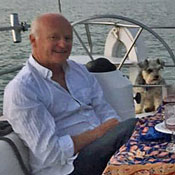
About the Author – Robert Cross
Robert Cross is the owner and principal yacht charter consultant at Sail Connections. A lifelong sailor, his experience includes skippering charter yachts in the Greek Islands, blue-water cruising, yacht racing and boatbuilding. Since taking over Sail Connections in 2010, Robert has drawn on his extensive sailing experience and worldwide charter industry knowledge to help clients choose the right yachts, destinations and operators for their sailing holidays.


